By Rachel Lewis, as told to Nicole Schmidt
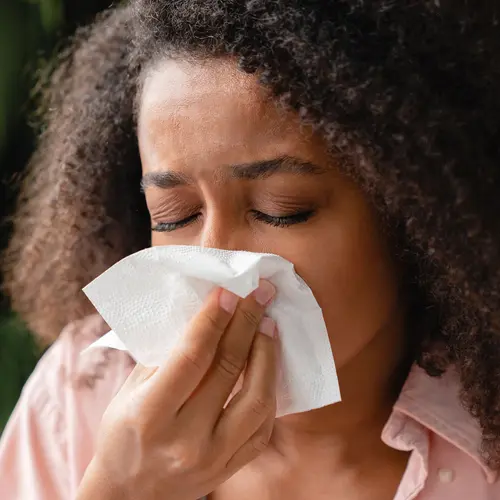
I’ve struggled with allergies for as long as I can remember. As a little kid, I had to take Kleenex and my inhaler everywhere I went. My mom was constantly giving me Benadryl because I always seemed to be having some sort of reaction.
The health problems only seemed to get worse as I got older. In college, I was diagnosed with chronic bronchitis, and by the time I was 25, I was on blood pressure medicine. I also dealt with constant GI issues: a steady rotation of bloating, constipation, and diarrhea. Even though I was a very athletic kid, I started to feel like such an unhealthy person. My friends joked that I needed to live in a plastic bubble.
My first real clue that something else might be going on came in 2020. One day, out of nowhere, my entire body felt like it was on fire. I could breathe fine — which was odd because usually, my allergic reactions triggered an asthma attack — but the burning sensation went all the way down to my toes. My heart rate and blood pressure also shot up, and I felt like I was going to pass out.
At first, I tried to explain it away. I had recently moved from New Mexico to Tennessee, so I figured maybe it was the change in vegetation or humidity. My boyfriend at the time had also spilled some clove oil in his bag and I put it in the laundry — maybe it had gotten into the washer and dryer and I was reacting to that. When I told my primary care doctor in Tennessee what was happening, they said it was probably just my allergies and asthma and that I shouldn’t worry about it.
In 2022, I moved back to New Mexico to start my dream job working as a wedding coordinator at a local resort. The hours were long and the work was stressful. On wedding days, I’d walk anywhere from 7 to 15 miles while shuttling between locations. The severe flare-ups kept happening and it eventually became too much. During my worst reactions, I felt this sense of doom — like I was going to die. I’d get so hot, my heart would start pounding and I’d throw up. I ended up leaving in 2024 and tried working at a brewery. But one day, I had a reaction so severe I had to be taken away on a gurney. After that, I started a part-time job at a hospital sleep center.
I’d had allergy testing done in college, but wanted to get retested to see if food might be causing my reactions. At the beginning of 2024, my new primary care doctor wrote me a referral to an allergist. For the first time, it felt like someone was actually listening to me. It meant a lot not to be brushed off.
I had to wait over three months before I could finally see the allergist. By then, I’d already been to the emergency room four times that year. During the appointment, he asked me a lot of questions about my health history, then sat back, looked at me, and said, “I don’t know what’s wrong with you, but I’m going to help you figure it out.”
He ordered what felt like an endless number of tests: blood work, a 24-hour urine collection, a stool test. Because I live in a small town, that meant a lot of time commuting to nearby cities for these appointments. All of the results came back normal.
My boss at the sleep center was incredible and really encouraged me to advocate for myself. We called my doctor together. I explained that I was still having issues and asked what the next step was. That’s when he said he wanted to send me for a bone marrow biopsy. I had it done three months later, in October.
One way to get a diagnosis of systemic mastocytosis happens when your bone marrow biopsy shows abnormal levels of mast cells. You may also have elevated serum tryptase levels (an enzyme released by mast cells when they detect a threat). My initial tests came back normal, which meant my levels needed to be checked when I was having a reaction. The first time I went to the emergency room and asked for a serum tryptase test, they told me they don’t do that there. So I had to go back to my doctor, get a special order, and then return to the ER with the paperwork in hand. I finally received an official diagnosis of indolent systemic mastocytosis in January 2025.
On the one hand, I felt a huge sense of relief because I finally had an answer. At the same time, I had the realization that this was my new normal. You can’t tell by looking at me that I have this disease, but it’s affected so much of my life. I can’t do a lot of the things I used to.
I’ve been on the medication avapritinib (Ayvakit) for a year now, which targets and lowers the number of abnormal mast cells in my system. But it also makes me tired and more sensitive to certain triggers, like heat and fragrance. On top of that, I take many antihistamines per day. I have to set alarms to make sure I take all my medications on time because if I miss a dose — even by 30 minutes — I can start having reactions. Being sick feels like a full-time job.
I had to leave my job at the sleep center because I was so easily irritated by the smell of people’s perfumes. Laundry is another big challenge. I go to a laundromat and even though I use fragrance-free detergent, exposure to other people’s products is enough to turn my arms red. I try to avoid doing laundry at all costs. Even something as simple as getting my hair done isn’t easy. I have to bring all my fragrance-free products to the salon and make sure it’s a small space. If I want to dye or bleach my hair, there’s a real chance I’ll have a reaction. It feels like there’s a level of anxiety attached to everything I do.
The medication has helped with symptom relief, and after a year, I’m finally starting to see some light at the end of the tunnel. In 2024, I was in the ER 13 times. Last year, in 2025, it was only four times, which feels like a huge improvement. Now I can go several days without a reaction, and when they do happen, they’re usually milder. Most of the time, I can manage them with Benadryl and ice packs. There’s still room for improvement, but the progress feels hopeful.
I started counseling not long after I began seeking a diagnosis and it’s the best thing I’ve done for myself. I’ve also joined a few different mast cell disease groups on Facebook. Knowing I’m not alone — that there are other people out there dealing with the same struggles — has made a big difference.
I always encourage people to advocate for themselves, to push back when something doesn’t feel right, and to get a second opinion if necessary. Unfortunately, a lot of people with mast cell disease have been dismissed or overlooked for years, but we deserve a lot more care and understanding than people realize.
 Related Links